
Screening Interview Questions: What to Ask and How to Score the Answers
Most small teams ask screening questions without ever deciding what a good answer actually looks like. The result is a set of notes, a gut impression, and a decision that's hard to defend or repeat with the next candidate. Two interviewers can walk away from the same call with a completely different read on the same person, because nobody agreed in advance on what "strong" meant.
This guide covers the full process: what a screening interview is actually for, the screening interview questions to ask by category, what each question is designed to reveal, what strong and weak answers look like, how to score responses consistently, which questions belong in a knockout check, and how to keep the whole process fair.
What Is a Screening Interview?
A screening interview is a short, early-stage conversation used to check essential qualifications, role relevance, motivation, and practical constraints before investing time in a longer interview.
It sits at a specific point in the hiring process, and it's worth being precise about three terms that get used interchangeably:
- Application screening — reviewing the CV or application itself, before any conversation happens.
- Screening interview — asking the candidate questions directly, usually by phone or video, to confirm fit before a deeper interview.
- Structured interview — asking comparable questions to every candidate and scoring the answers against criteria decided in advance. The U.S. Office of Personnel Management's structured interview guidance explains why predetermined questions and consistent rating standards make comparisons more reliable.
A screening interview can be structured or unstructured. This guide assumes you want it structured, because that's what makes the results comparable across candidates rather than just a collection of separate impressions.
What Should a Screening Interview Assess?
Keep the assessment focused on five areas:
- Minimum qualifications — the non-negotiable requirements for the role.
- Relevant experience — how closely their background maps to the actual work.
- Job-related skills — the specific abilities the role requires, not general competence.
- Motivation and expectations — why now, and whether the role matches what they're looking for.
- Practical requirements — availability, location, compensation expectations, work authorization.
Avoid vague concepts like "culture fit" unless you can translate them into something observable. "Works well with a small, fast-moving team" is assessable. "Good vibe" is not, and it's also where inconsistent, unfair decisions tend to creep in.
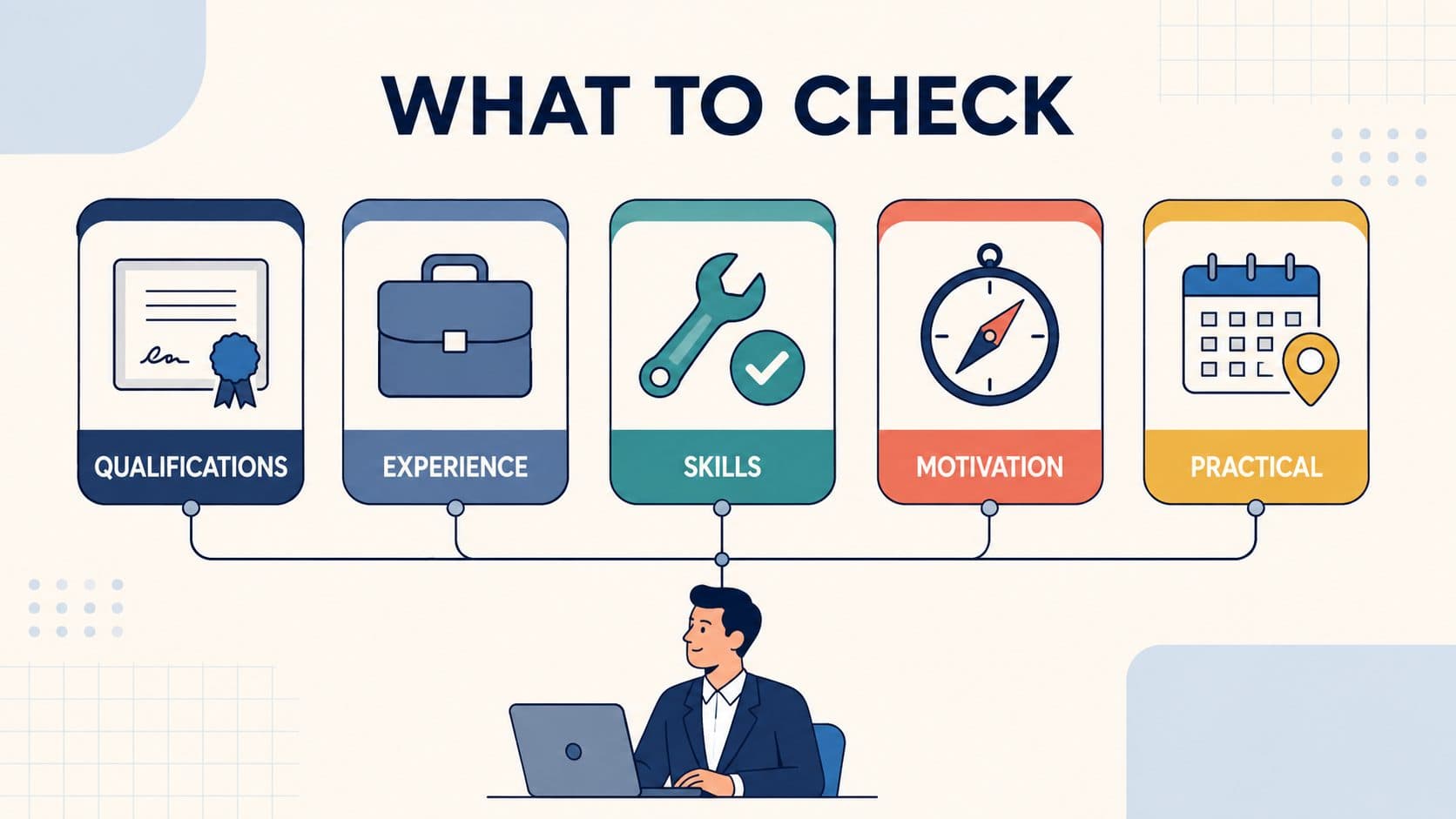
Start with the requirements that actually determine success in the role.
How Many Screening Questions Should You Ask?
A rough guide:
- 5–8 questions for a 15-minute screen
- 8–12 questions for a 30-minute screen
- 3–5 application questions before the interview even happens
- One or two follow-up prompts when an answer lacks evidence
This guide includes roughly 30 questions across categories, but that's a library to select from, not a script to run through in one call. Asking all 30 questions in a single screening conversation creates fatigue for both sides and actually reduces the quality of the answers you get. Pick the 6–10 that map to what this specific role actually requires.
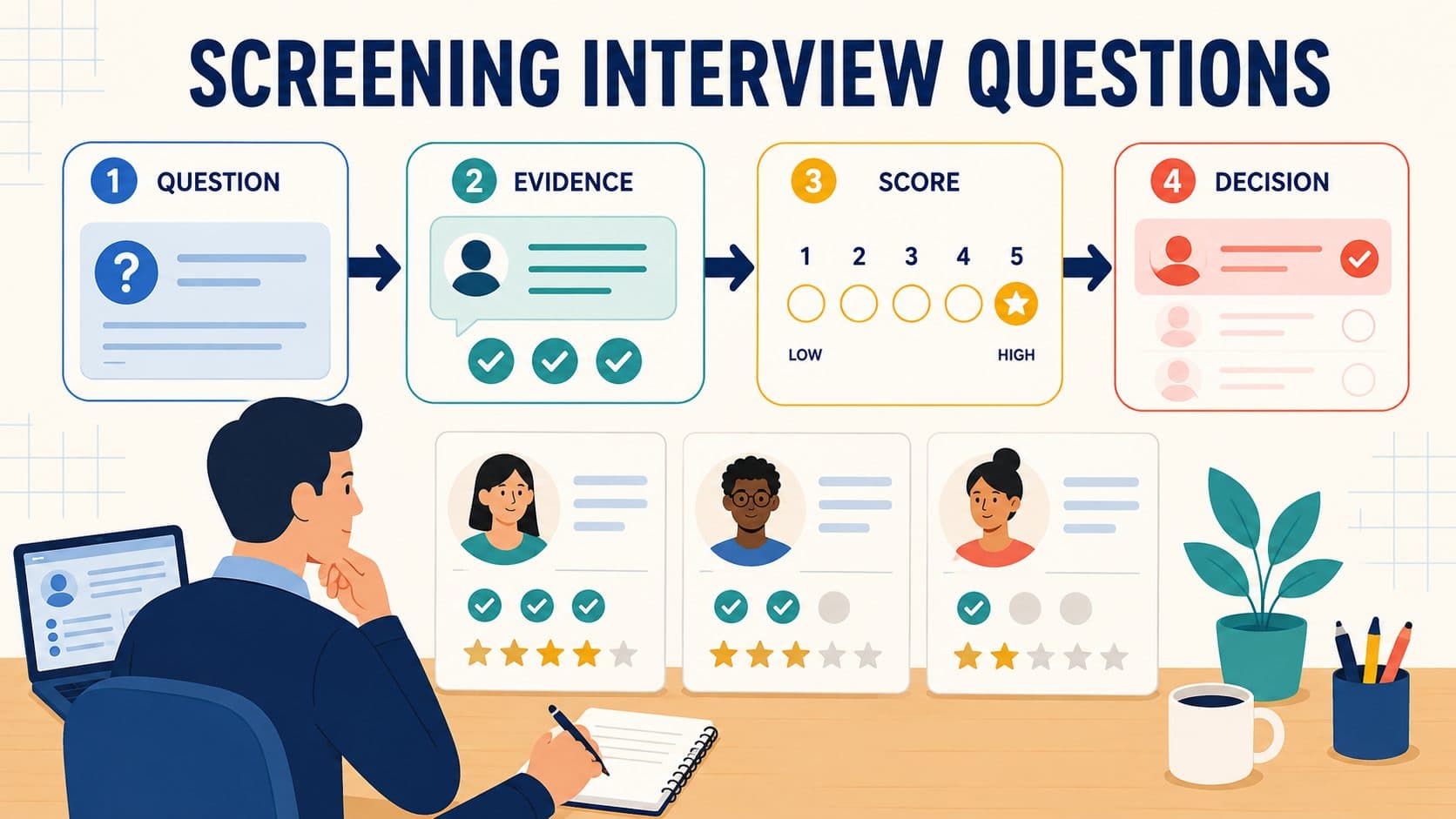
The Core Framework: Question → Evidence → Score → Decision
Every question below is only useful if you know what you're listening for and how you'll judge the answer. The framework is simple:
- Question — what you ask.
- Evidence — what a real answer, backed by specifics, sounds like.
- Score — a consistent rating so answers are comparable across candidates.
- Decision — what the score actually means for whether this person moves forward.
Keep this loop in mind through every section below — it's what separates a useful screening question from one that just fills fifteen minutes.
Screening Interview Questions by Category
Background and Role Relevance
- "Can you briefly walk me through the experience most relevant to this role?"
- "What responsibilities took up most of your time in your last position?"
- "Which part of your previous role best prepares you for this one?"
- "What type of work are you hoping to do next?"
- "What attracted you to this particular role?"
These questions establish context more than they produce a hard score. Listen for whether the candidate can connect their actual past responsibilities to what this role needs, rather than describing their old job in isolation. A candidate who says "I handled customer complaints and usually resolved them without escalating" is giving you something concrete. A candidate who says "I'm a people person" is not — that's a claim, not evidence. Use these mostly for context and fit rather than a hard numeric score, except where a specific answer reveals a genuine mismatch with the role.
Skills and Experience
- "Which tools or systems have you used that are relevant to this role?"
- "Tell me about a project where you had to deliver a measurable result."
- "What is the most difficult task you have handled in this type of role?"
- "How do you check the quality of your work?"
- "Tell me about a time you had to learn a new tool quickly."
The instinct here is to listen for tool names and tick them off a list. Resist it. A candidate naming a tool is weaker evidence than a candidate explaining how they actually used it to solve a real problem. "I've used Zendesk" tells you almost nothing. "I used Zendesk's tagging system to spot a recurring bug pattern and flagged it to engineering before it became a wider issue" tells you they understand the tool as a means to an end, not just a line on a resume.
Behavioral Questions
- "Tell me about a time you missed or nearly missed a deadline."
- "Describe a disagreement with a colleague and how you handled it."
- "Tell me about a time you received difficult feedback."
- "Describe a time you had to prioritize competing tasks."
- "Tell me about a mistake you made and what changed afterward."
Score these against a simple evidence model: Situation, Action, Result, Reflection. A strong answer doesn't need to be polished or rehearsed. It needs a specific situation (not "this happens a lot"), the candidate's own actions (not the team's actions), a credible result, and — ideally — some sign they took something away from it. An answer that stays vague throughout ("I just try to stay calm and communicate") without ever landing on a specific instance is a weak answer regardless of how confidently it's delivered.
Situational Questions
- "What would you do if two urgent customers needed help at the same time?"
- "How would you handle a task you had never performed before?"
- "What would you do if you disagreed with your manager's instructions?"
- "How would you prioritize your first week in this role?"
- "What would you do if you realized a deadline could not be met?"
Situational questions are useful when the role involves predictable, recurring challenges — you're testing judgment against a scenario you already know will come up. They're weaker than behavioral questions on their own, though, because they ask what someone thinks they'd do rather than what they've actually done. Use them to supplement behavioral evidence, not replace it.
Motivation and Expectations
- "Why are you considering a move now?"
- "What would make this role a good next step for you?"
- "What type of management helps you do your best work?"
- "What would you want to understand about this role before moving forward?"
- "What are your expectations for the first few months?"
Assess motivation separately from competence, and don't let one substitute for the other. Genuine enthusiasm is a real, useful signal — but it's not proof of ability, and a confident, motivated answer to a competence question shouldn't move a score that the actual evidence doesn't support.
Practical and Eligibility Questions
- "Are you available to work the schedule described in the job posting?"
- "When could you start?"
- "Are you able to work from the stated location or time zone?"
- "Does the advertised compensation range match your expectations?"
- "Are you legally authorized to work in the relevant country, where applicable?"
Word this section carefully. Confirm work authorization and practical availability without asking anything about citizenship, nationality, family circumstances, health, age, religion, or disability. The EEOC's guidance on pre-employment inquiries is a useful reference here: information requested before employment should be limited to what's genuinely essential for determining whether someone is qualified to do the job. If a global audience is relevant to your hiring, Acas's guidance on interviewing job applicants is also worth reviewing — it covers consistent questioning, reasonable adjustments, and recording permissions in more detail than most US-focused resources do.
How to Score the Answers
This is the part most screening advice skips, and it's the difference between a list of questions and an actual process.
For each important question, use a consistent structure. HireMike's interview scorecard template provides a reusable version of this format.
| Field | Explanation |
|---|---|
| Question | The exact question asked |
| What it assesses | The specific job-related competency |
| Strong evidence | Specific behaviors, actions, and results |
| Weak evidence | General claims, no ownership, no concrete example |
| Score | 1–5 |
| Decision use | Progress, clarify further, or reject only if job-critical |
Use a practical 1–5 scale for each competency:
- 1 — No relevant evidence, or the answer directly conflicts with a must-have requirement.
- 2 — Limited evidence, mostly general statements.
- 3 — Adequate evidence with some relevant detail.
- 4 — Strong, specific evidence clearly connected to the role.
- 5 — Clear, highly relevant evidence with measurable impact and thoughtful reasoning.
Score each competency separately. A single overall "impression" score collapses too much information — a candidate might be a 5 on communication and a 2 on prioritization, and averaging that into a 3.5 tells you nothing useful about who you're actually hiring.
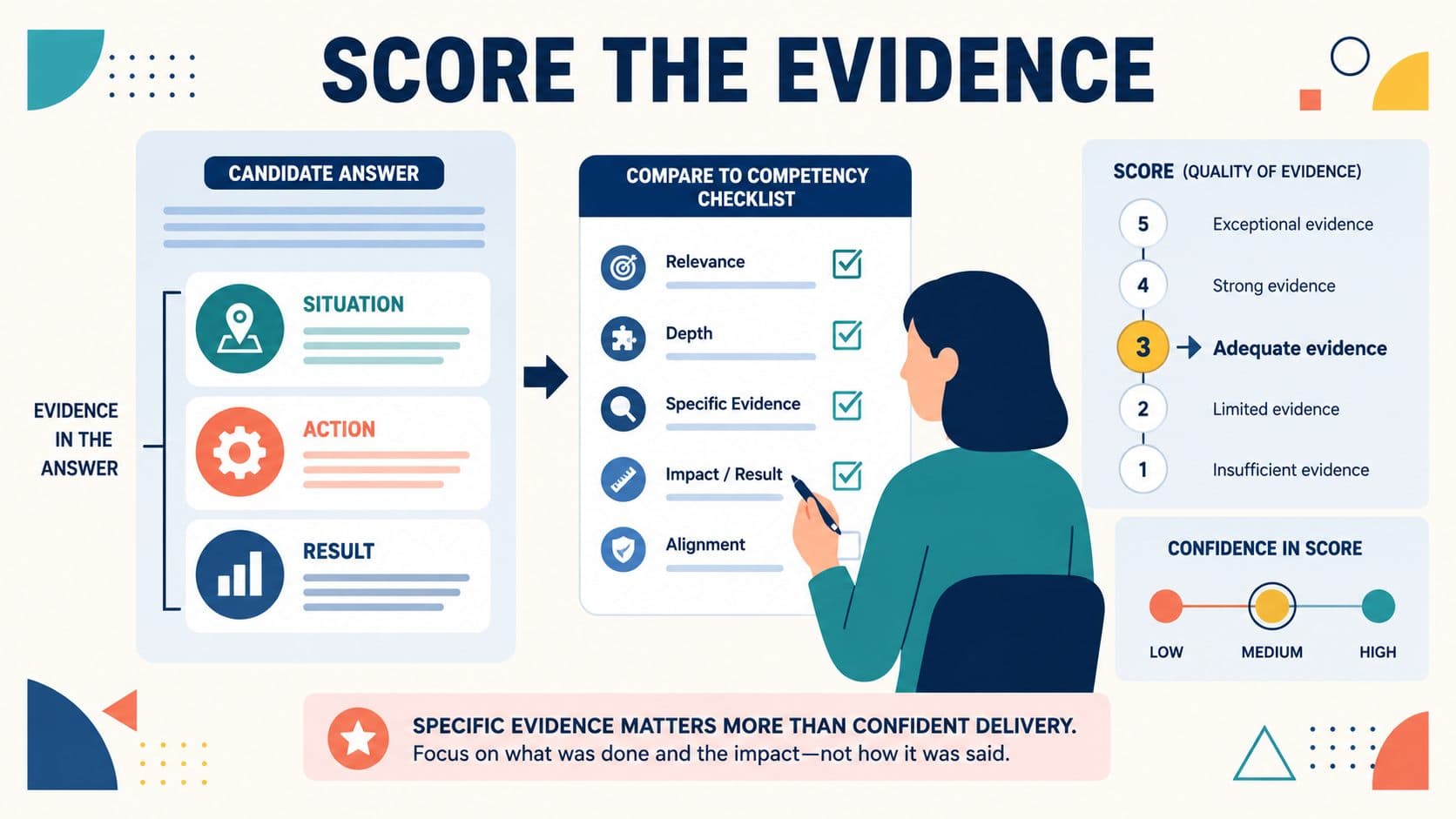
Score the evidence in the answer, not the confidence of its delivery.
The Three Layers of Scoring Logic
Layer 1: Knockout Gates
These are binary, yes/no checks tied to genuine requirements — not preferences:
- Required license or certification
- Required work authorization
- Required location or schedule
- A non-negotiable technical requirement
- Minimum availability
- Any legally required eligibility condition
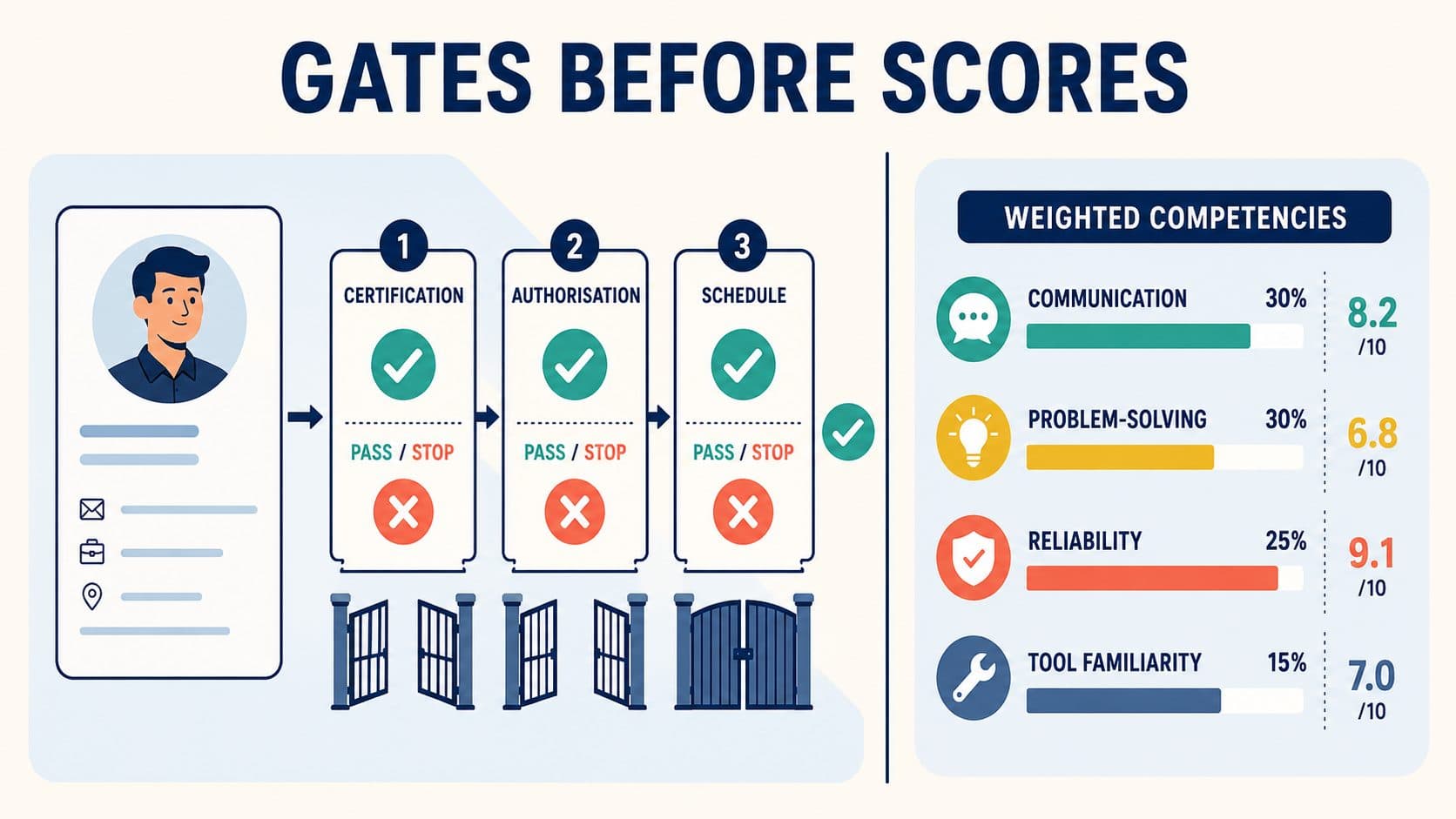
Essential requirements are gates; learnable capabilities belong in the score.
A failed gate should not be averaged away by strong communication or enthusiasm elsewhere. If the role requires a specific certification and the candidate doesn't have it, no amount of charisma changes that math.
Layer 2: Weighted Competencies
Weight competencies according to what the role actually needs. For a customer-support role, that might look like:
- Relevant customer experience: 25%
- Communication: 20%
- Problem-solving: 20%
- Reliability and ownership: 20%
- Tool familiarity: 15%
These weights should shift meaningfully for a different role. Don't reuse the same scorecard for a sales role and an administrative role and expect it to mean anything.
Layer 3: Evidence Confidence
Alongside the score, add a confidence label:
- High confidence — a specific example, clear personal ownership, a verifiable result.
- Medium confidence — a relevant answer, but limited detail.
- Low confidence — a generic claim, unclear contribution, no concrete example.
This matters because not every score deserves equal trust. A 4 with high confidence and a 4 with low confidence are not the same signal, even though the number looks identical on paper.
Structured interviews — predetermined questions, consistent rating standards, job-related competencies — are well-supported as a more reliable predictor of performance than unstructured conversation. The U.S. Office of Personnel Management's guidance linked above is a solid reference if you want the underlying research.
Knockout Questions: What to Check Before a Full Interview
A knockout question should:
- Be directly tied to a genuine job requirement
- Be asked consistently, to every candidate
- Have a clear yes/no or factual answer
- Be reviewed before any subjective scoring happens
- Be written in plain, unambiguous language
Do not use knockout questions for vague preferences dressed up as requirements — "Are you a culture fit?" or "Are you highly motivated?" are not knockout questions, they're opinions with no clear failure condition.
A knockout question should only remove a candidate when the requirement is genuinely essential to performing the job. If the requirement is something that could reasonably be learned on the job, score it as a competency instead of treating it as an automatic rejection.
A Practical Screening Process for Small Businesses
- Define three to five job-critical competencies before you write a single question.
- Separate must-have gates from scored capabilities — decide which is which before candidates start applying.
- Select five to eight screening questions from the categories above, matched to those competencies.
- Ask the same core questions to every candidate — this is what makes comparison possible at all.
- Score immediately after the interview, while the answers are fresh, not at the end of a batch of five calls.
- Review the evidence before deciding who progresses — not the general impression you were left with.
This kind of repeatable hiring process follows the same operational principle as guided workflows for complex team processes: make the steps explicit, define the decision points, and keep a person responsible for the final call.
Worked example — Customer Support Representative:
Core competencies: communication (25%), problem-solving (25%), reliability (25%), tool familiarity (15%), customer empathy (10%). Knockout gates: availability for the posted schedule, minimum one year of customer-facing experience.
Sample questions used: "Tell me about a time you had to learn a new tool quickly" (tool familiarity), "Describe a disagreement with a colleague and how you handled it" (communication), "Tell me about a time you missed or nearly missed a deadline" (reliability), "What would you do if two urgent customers needed help at the same time?" (problem-solving, situational).
Each answer gets scored 1–5 against its competency, tagged with a confidence level, and reviewed against the weighting before a decision gets made — not right after the call, based on how the conversation felt.
Where AI Fits — and Where It Doesn't
Used well, AI can genuinely improve this process. It can help you:
- Ask consistent questions across every candidate
- Organize transcripts and notes so nothing gets lost
- Map responses back to the competencies you defined
- Flag where evidence is missing or thin
- Apply a predefined scorecard consistently
- Make side-by-side candidate comparison faster
HireMike's how-it-works guide shows how an AI-assisted hiring workflow can organize repeatable screening work while leaving advancement decisions with the employer.
It should not be used to infer personality from facial expressions or tone, treat accent or speech style as a proxy for competence, reject candidates without a human reviewing the decision, replace a reasonable accommodation process, or score something as vague as "culture fit." The EEOC's guidance on AI and the ADA is a useful reference if AI tools are part of your process — it's specific about where automated assessment can create legal and fairness risk if human review is skipped.
Frequently Asked Questions
What is a screening interview? A short, early-stage conversation used to confirm essential qualifications, relevant experience, motivation, and practical fit before a longer, deeper interview.
How many questions should you ask in a screening interview? Typically 5–8 for a 15-minute call or 8–12 for a 30-minute call. More than that tends to produce fatigue and weaker answers rather than better information.
What are the best screening interview questions for employers? The best questions are the ones tied directly to the specific competencies the role requires — not a generic list. Behavioral questions that ask for a real past example tend to produce the strongest evidence.
What is the difference between a screening interview and a full interview? A screening interview checks essential qualifications and fit quickly, usually in 15–30 minutes. A full interview goes deeper into skills, competencies, and role-specific scenarios, and typically involves more of the hiring team.
What questions should employers avoid asking? Anything touching citizenship, nationality, family or marital status, health, age, religion, or disability that isn't directly and legally required to confirm eligibility for the role.
How do you score screening interview answers? Score each competency separately on a consistent scale (such as 1–5), based on the specificity and relevance of the evidence in the answer — not on overall impression or confidence of delivery.
HireMike's guide to screening job applicants covers the wider process from application review through to interviews, and HireMike's hiring resource hub brings the supporting templates and process guidance together for teams that want to apply the same criteria across a larger applicant pool.
A consistent screening process only pays off if what happens after the offer is just as consistent. If your team is still figuring out how to make onboarding and performance expectations stick once someone is hired, Process Shepherd's guided workflows can help new hires ramp up faster and hit the ground running.