

AI Role-play Training for Customer Service: From Practice to Live Performance

AI role-play training for customer service helps contact centers connect realistic conversation practice, human coaching and workflow guidance to improve agent readiness.
Customer service agents rarely struggle because they have never seen a policy or read a customer support script. They struggle when they must listen to an upset customer, find the right information, make a judgement, and complete the correct process at the same time. That combination is difficult to reproduce with slide decks, quizzes or an occasional role-play with a supervisor.
AI role-play training gives agents a safer place to practice difficult conversations before a real customer is involved. The agent can respond to an adaptive customer persona, receive feedback and repeat the scenario until the response becomes more confident and consistent. Yet conversational practice is only one part of readiness. During live work, the agent must still choose the correct workflow, follow policy and document the interaction accurately.
The strongest training model connects those two stages. AI role-play builds conversational skill before the interaction. Human coaching develops judgment. Real-time workflow guidance supports accurate execution when the interaction is live. Production data then shows whether the training is improving actual performance.
Key takeaways
- AI role-play training gives customer service agents repeatable, low-risk practice with realistic conversations.
- The quality of the scenario, scoring rubric and feedback matters more than the novelty of the AI.
- Training success should be measured through readiness and live performance, not course completion alone.
- Role-play works best when it is connected to human coaching and guidance inside the agent's real workflow.
What AI Role-play Training for Customer Service Means
AI role-play training uses conversational artificial intelligence to simulate realistic workplace interactions. A customer service agent can practice responding to complaints, objections and escalations, receive immediate feedback and repeat the exercise without exposing a real customer to training mistakes.
The AI plays a defined role, such as a frustrated subscriber, a confused patient or a customer disputing a charge. It responds to what the agent actually says rather than moving through a fixed sequence of answers. A strong response may calm the simulated customer. A vague answer, missed question or defensive tone may cause the persona to resist or escalate.
Platforms such as Sethco AI provide a controlled environment where employees can rehearse high-stakes conversations before they handle them in real situations. This kind of practice is different from reading a script or completing a multiple-choice course because the learner must produce a response, observe the result and adjust.
AI role-play is also different from a basic customer service chatbot. The goal is not to resolve the simulated customer's problem as efficiently as possible. The goal is to create a useful learning experience: a credible scenario, a clear standard for good performance, feedback tied to observable behaviour and enough repetition for the learner to improve.
Why traditional customer service role-play falls short
Role-play remains useful, and it belongs inside a broader call center agent training program. The problem is that traditional role-play is difficult to deliver often and consistently.
Human practice is difficult to schedule
Manager-led role-play consumes time from supervisors and experienced agents. In a busy contact center, coaching sessions compete with queue coverage, quality reviews, escalations and daily operational work. Practice is often postponed until the next formal training session, even when the agent needs help immediately.
Practice quality varies
A skilled facilitator can make a scenario feel realistic and provide precise feedback. An unprepared partner may make the conversation too easy, follow a script mechanically or offer advice such as 'sound more confident' without explaining what the agent should do differently. When practice quality depends on the facilitator, learners receive uneven preparation.
Employees may play safely when colleagues are watching
Peer role-play can feel like a public assessment. Some agents avoid experimenting because they do not want to look unprepared in front of a manager or colleague. Private AI practice can lower that social pressure and make it easier to try a response, fail, review the feedback and try again.
Agents do not get enough repetition
Skill develops through focused practice and feedback, not exposure alone. The research literature on deliberate practice emphasises repeated work on specific aspects of performance. A training session with one or two exercises can introduce a technique, but it rarely gives an agent enough attempts to apply that technique under different levels of pressure.
Conversation practice is often separated from process execution
An agent can sound empathetic during role-play and still fail on the live interaction. Customer service work also requires system navigation, verification, policy interpretation, documentation and accurate handoffs. When training treats conversation skills and operational workflows as separate subjects, the transition to production remains difficult.
How AI Role-play Training Works
An effective AI role-play program follows a repeatable cycle. The technology can automate parts of the experience, but trainers and operational leaders still define the behaviour that the exercise should develop.
- Define the interaction. Select a customer problem and one clear learning objective, such as de-escalating an angry caller without making an unsupported promise.
- Create the customer persona. Describe the customer's history, emotional state, knowledge, communication style and desired outcome.
- Run the conversation. The simulated customer responds to the agent's questions, tone and decisions in real time.
- Evaluate observable behaviour. Score the interaction against defined criteria such as acknowledgment, discovery, accuracy, compliance and resolution.
- Provide targeted feedback. Identify what worked, show where the interaction went off track and recommend a more effective response.
- Repeat with controlled variation. Change the customer's temperament, the complexity of the issue or the information available to the agent.
- Escalate to human coaching when needed. Managers address context, judgment and persistent gaps that automated feedback cannot resolve well.
The feedback should stay close to the practice attempt. A large review of feedback interventions found that feedback does not improve performance automatically; its effect depends on how the feedback directs attention and what the learner can do with it. In practical terms, an AI coach should point to a specific behaviour and a useful next attempt rather than produce a long, generic critique.
For additional context, see the published review of feedback interventions and performance.
What makes an AI role-play scenario effective

Effective scenarios combine a focused objective, a believable persona, real operational context and a transparent scoring rubric
A specific learning objective
Each scenario should test one main capability. A billing-dispute exercise might focus on acknowledgment and explanation. A verification exercise might focus on maintaining security while keeping the customer informed. Combining every possible skill into one scenario makes the feedback harder to interpret and the exercise harder to repeat deliberately.
Context drawn from real interactions
The best source material is operational evidence: anonymized call patterns, quality findings, escalation categories, policy changes and common reasons for repeat contact. Hypothetical situations can be useful, but they should resemble the decisions and constraints agents face in production.
A believable customer persona
A persona needs more than an emotion label. It should include the customer's goal, relevant history, level of product knowledge, communication style and likely objections. Good scenario-based training with AI characters depends on focused learning objectives and believable reactions.
Adaptive difficulty
New agents may begin with a straightforward customer who accepts a clear explanation. Experienced agents can face ambiguous facts, competing demands, repeated objections or a customer who remains dissatisfied after the correct policy has been explained. Difficulty should rise deliberately rather than unpredictably.
A transparent scoring rubric
Agents should know how the exercise will be evaluated. A useful rubric can cover active listening, empathy, accuracy, compliance, ownership and the quality of the resolution. The scoring system should be tested against human judgment before managers use it to certify readiness.
Actionable feedback
Feedback should identify the relevant moment, explain why it mattered and suggest a better response. 'You lacked empathy' is vague. 'You moved to the refund policy before acknowledging why the charge was surprising' gives the agent something concrete to change on the next attempt.
Customer service role-play scenarios worth practicing
Scenario selection should follow business risk and frequency. The following examples cover conversations that require both communication skill and accurate operational execution.
| Scenario | Agent objective | Skills evaluated | Operational risk |
|---|---|---|---|
| Unexpected billing charge | Explain the charge and restore confidence | Listening, empathy, explanation | Incorrect credit or escalation |
| Refund outside policy | Explain the limit and offer valid alternatives | Policy communication, judgment | Unauthorised refund |
| Angry customer escalation | Lower the emotional temperature before solving | Acknowledgment, pacing, de-escalation | Complaint, churn or supervisor transfer |
| Account access problem | Restore access while following verification rules | Clarity, security, accuracy | Privacy or compliance failure |
| Service outage | Set expectations without unsupported promises | Transparency, expectation setting | Incorrect commitment |
| Cancellation request | Understand the reason and select the right next step | Discovery, retention, judgment | Unnecessary churn |
Example scenario for a disputed charge
The customer notices a charge that is higher than expected and begins the interaction irritated. The customer believes the company changed the price without warning. The agent's goal is to acknowledge the concern, establish what changed, explain the charge accurately and offer only the remedies allowed by policy.
- Persona: a long-term customer who understands the basic product but has not read the latest billing notice.
- Trigger: the agent gives a policy explanation before confirming which charge the customer is questioning.
- Adaptive response: the customer becomes more resistant if the agent sounds defensive, but becomes more cooperative after a clear acknowledgment and a focused question.
- Behaviours to score: acknowledgment, question quality, explanation, policy accuracy, ownership and documentation.
- Common failure: offering a credit before verifying eligibility or making a promise the billing team cannot honor.
- Successful outcome: the customer understands the charge, receives an accurate next step and knows when to expect the next update.
Why good role-play scores do not always translate into live performance
A simulation reduces some of the demands present in live work. The agent may have a clean screen, a single objective and no queue pressure. A real customer interaction requires the agent to listen, regulate the tone, search for information, navigate several systems, interpret policy, document the interaction and manage time.
That difference creates a transfer gap between demonstrating a skill in training and applying it accurately under production conditions. A high simulation score is encouraging, but it should not be treated as proof of readiness until it is compared with live quality results. The same principle applies to reducing agent errors: training can improve knowledge, while the work environment must still make the correct action clear and accessible.
The transfer gap is especially important in complex contact centers. An agent can use excellent de-escalation language and still skip identity verification. Another agent may select the correct policy but struggle to explain it in a way the customer understands. The training design should therefore cover both the conversation and the operational steps that turn the conversation into a correct outcome.
The practice to performance framework
A complete training system connects practice data with production evidence. The following framework creates a continuous loop between what agents rehearse, how managers coach and what happens during live work.
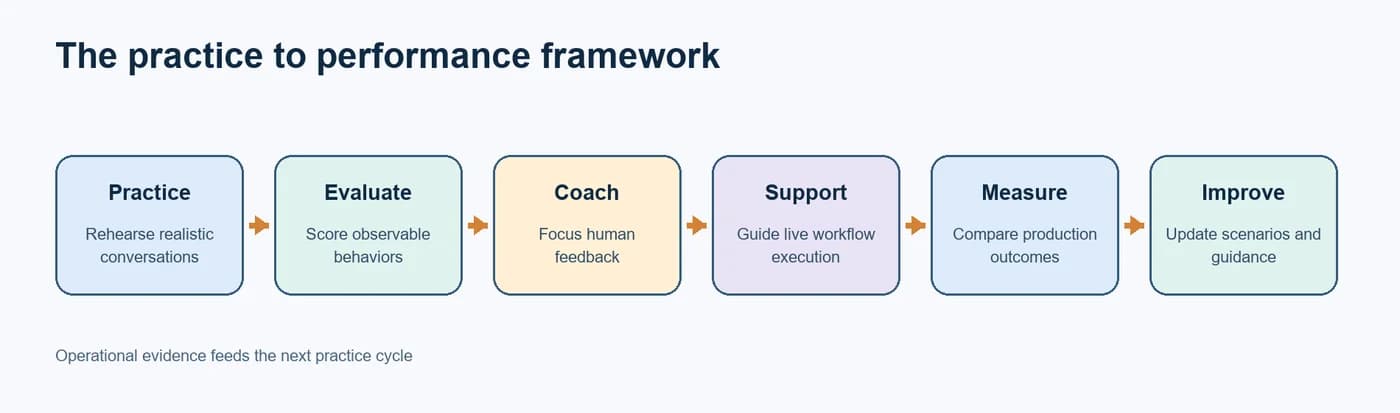
Practice, evaluation, coaching, live support and measurement form one improvement cycle
Practice realistic conversations
Agents rehearse the interactions that create the most risk, cost or customer frustration. Guidance on teaching customer interaction skills through active practice reinforces a basic principle: employees need opportunities to perform a skill, observe the result and improve the next attempt.
Evaluate observable behaviour
The score should reflect behaviours the organisation has defined as important. That might include whether the agent acknowledged the concern, asked an appropriate diagnostic question, used accurate information and reached a valid outcome.
Focus human coaching
Managers use practice data to find patterns instead of reviewing every attempt. Human coaching can then concentrate on judgment, emotional nuance and the situations where automated feedback remains uncertain.

Human coaches can use role-play evidence to discuss a specific moment, decision or communication pattern
Support live workflow execution
Process Shepherd can guide agents through the required steps during live work. This reduces dependence on memory and helps the agent apply the right process while continuing the customer conversation.
Measure production outcomes
Compare training performance with live quality assurance results, error rates, escalations, repeat contacts and customer outcomes. Look for patterns over time rather than assuming that a single strong practice score will produce a better live interaction.
Improve the next training cycle
Use production evidence to revise scenarios and workflow guidance. If a policy change creates repeat errors, the team can update the live process and build a new practice scenario around the same decision.
How AI role-play and workflow guidance work together
AI role-play and workflow guidance address related parts of agent performance. They do not perform the same job, and one does not eliminate the need for the other.
| Capability | Primary purpose | Best time to use it |
|---|---|---|
| AI role-play | Practice realistic conversations and receive repeatable feedback | Before live work and during ongoing development |
| Human coaching | Develop judgment, context and emotional nuance | After patterns or difficult cases emerge |
| Workflow guidance | Help the agent execute the correct operational process | During the live interaction |
| Quality and performance data | Identify gaps and test whether training transfers | After practice and production interactions |
In practical terms, an agent might first practice a refund conversation with an AI customer. A manager then reviews the pattern of mistakes and coaches the agent on judgment. During the real interaction, workflow guidance presents the approved refund process and required documentation. Quality data from the live case shows whether the combined approach improved the result.
This model also strengthens the employee onboarding process because new hires can move from explanation to practice and then to supported production with clearer evidence of readiness.
How to measure whether AI role-play training works
Completion rates show participation, not skill. Measurement should follow the learner from practice into production and distinguish early indicators from business outcomes.

Useful measurement connects practice activity and readiness indicators with live quality and customer outcomes
Practice metrics
- Number and frequency of practice attempts
- Improvement between comparable attempts
- Performance by skill or rubric category
- Consistency across personas and difficulty levels
- Feedback themes that recur across the team
Readiness metrics
- Percentage of agents reaching a defined performance standard
- Time required to demonstrate readiness
- Performance on unfamiliar or more difficult scenarios
- Skills that still require manager intervention
Live performance metrics
- Quality assurance scores
- Agent error and rework rates
- First contact resolution
- Escalation and transfer rates
- Repeat contacts
- Customer satisfaction
- Average handle time, interpreted alongside quality
- Policy or compliance failures
Better practice scores do not automatically prove business impact. Compare training data with live outcomes over a defined period. Where possible, account for tenure, queue type, case difficulty and changes to policy or staffing. Avoid optimising one metric in isolation. Lower handle time is not an improvement if it increases repeat contact or reduces resolution quality.
How to implement AI role-play training
Start with one measurable interaction
Choose a frequent or costly interaction where performance varies. Billing escalations, verification failures and retention conversations are useful candidates because the organisation can define the desired process and observe the result.
Build the scenario from verified evidence
Review anonymised quality findings, escalation reasons, policy requirements and examples from experienced agents. Remove customer-identifying information before using operational material in a training system.
Define the scoring rubric before launch
A trainer, operational leader and subject-matter expert should agree on the behaviours that matter. Test the rubric on several sample responses. If experienced reviewers disagree with the automated score, investigate the cause before using the score for readiness decisions.
Test with experienced agents
Ask experienced agents whether the customer behaviour, language and objections feel authentic. Their feedback can reveal unrealistic assumptions, missing exceptions and policies that are difficult to apply in practice.
Run a controlled pilot
Establish baseline performance, introduce the scenario to a limited cohort and compare results over time. A pilot should test both learning quality and operational feasibility, including how long scenarios take, how managers review results and how quickly content can be updated.
Make practice part of normal work
If role-play is presented only to underperformers, employees may treat it as remedial. Use it during onboarding, before launches, after policy changes and as preparation for difficult conversations. Short, focused sessions are easier to repeat than occasional large training events.
What to look for in an AI role-play platform
The best platform is the one that supports the organisation's real scenarios and governance requirements. An impressive demonstration is not enough. Evaluate how the system will be maintained after the initial launch.
- Adaptive conversations rather than fixed decision trees
- Realistic voice timing and interruption handling where voice practice matters
- Control over personas, objectives and difficulty
- Company-specific knowledge and scenario inputs
- Custom scoring rubrics and explainable feedback
- Progress data that managers can interpret
- Accessibility and appropriate language support
- Documented security, retention and deletion controls
- Clear disclosure of whether customer or employee data is used to train models
- LMS or training-system compatibility where required
- Export options and administrative controls
For AI governance, the NIST AI Risk Management Framework provides a useful structure for identifying and managing risks across the AI lifecycle. Organisations should adapt their review to the sensitivity of the employee and customer data involved.
Limitations and risks
AI role-play is useful when its limits are explicit. A simulated customer may sound credible without reproducing the uncertainty, cultural context or emotional complexity of a real person. Automated scoring can also reward surface patterns while missing whether the response was appropriate for the situation.
- Test performance across accents, dialects, languages and communication styles represented in the workforce.
- Do not insert customer-identifying information into a training system without approved safeguards.
- Explain to employees what data is collected, who can see it and how long it is retained.
- Review scoring for bias and disagreement with qualified human evaluators.
- Do not use an automated practice score as the sole basis for a consequential employment decision.
- Keep human coaches involved in judgment-heavy, sensitive and unusual situations.
- Update scenarios when products, policies, risks or customer behaviour change.
The OECD AI Principles offer additional guidance on human-centered values, transparency, robustness and accountability. These principles are broad, so each organisation still needs specific controls for its training context.
Frequently asked questions
What is AI role-play training
AI role-play training uses conversational AI to simulate realistic interactions for practice. In customer service, the AI can play a customer with a particular problem, personality and emotional state. The agent responds, receives feedback and repeats the scenario to improve specific skills.
Is AI training available for customer service professionals
Yes. Customer service teams can use AI simulations for complaints, billing questions, de-escalation, account access, retention and other recurring interactions. The useful systems allow trainers to tailor the persona, scenario, scoring criteria and feedback to the organisation's actual work.
What are good role-play scenarios for customer service
Good scenarios combine a realistic customer problem with a clear learning objective. Common examples include disputed charges, refunds outside policy, angry customers, identity verification, service outages, cancellations and sensitive handoffs. Choose scenarios from real quality findings and operational risks.
Can AI simulate an angry customer
AI can simulate changing levels of frustration and respond differently based on the agent's language. The realism depends on the platform and scenario design. Trainers should test whether the persona reacts credibly and avoid confusing aggression with useful difficulty.
Does AI role-play replace human coaching
No. AI can provide repetition, consistent scenarios and immediate feedback. Human coaches are still needed for context, judgment, emotional nuance and unusual cases. AI is most useful when it gives managers better evidence about where their coaching time will have the greatest value.
How often should customer service agents practice
There is no universal frequency. Short, recurring practice tied to current performance gaps is generally more useful than a single annual exercise. Teams can schedule practice during onboarding, before a product launch, after a policy change or when quality data reveals a repeated problem.
How do you measure the return from AI role-play training
Measure improvement in comparable practice attempts, the time required to demonstrate readiness and changes in live outcomes. Useful production measures include quality scores, errors, escalations, repeat contacts, resolution rates and customer satisfaction. Interpret the results alongside changes in staffing, tenure, case mix and policy.
Can AI role-play reduce customer service errors
It can help agents recognise situations and practice the correct response, but conversation training does not address every source of error. Mistakes caused by complex systems, unclear processes or missing information may also require workflow redesign and real-time guidance.
Is employee role-play data private
Privacy depends on the provider and the organisation's configuration. Buyers should review what is recorded, who can access it, how long it is retained, whether it is used to train models and how it can be deleted. Employees should receive a clear explanation before participating.
Turning practice into dependable performance
AI role-play training can give customer service agents something traditional programs struggle to provide: frequent practice with difficult conversations and feedback close to the moment of learning. Its value depends on scenario quality, transparent evaluation and a clear connection to the work agents perform.
The final test is not whether an agent completes the simulation or earns a high score. It is whether the agent can handle a real customer accurately, confidently and consistently. AI role-play prepares the conversation. Human coaching develops judgment. Process Shepherd can support the correct workflow when the conversation becomes real.
To connect agent training with supported live work, book a Process Shepherd demo or contact our team about guided workflows for your customer service operation.
Sources and further reading
- Process Shepherd call center agent training guide
- Process Shepherd guide to reducing agent errors
- Process Shepherd employee onboarding process guide
- Sethco AI
- Sethco guide to scenario based training
- Sethco guide to customer interaction skills
- Ericsson Krampe and Tesch Romer on deliberate practice
- Kluger and DeNisi on feedback interventions
- NIST AI Risk Management Framework
- OECD AI Principles
Nola Neven
AuthorNola Neven is a content strategist in the CX space, focused on turning complex operational problems into clear, credible content that people actually read, reference, and share. Her work sits where content and operations meet. She spends her time understanding how contact centers and help desks really function day to day, where workflows break down, where teams rely on workarounds, and where systems quietly slow everything down.