What Is Average Handling Time (AHT) in a Call Center? (+ How to Actually Improve It)

What Is Average Handling Time (AHT) in a Call Center? (+ How to Actually Improve It)
Average handling time (AHT) is the average amount of time an agent spends on a single customer interaction — from the moment they pick up to the moment any follow-up work is done. It's one of the most tracked metrics in any call center, and one of the most consistently misused. Teams chase a lower number without checking what they're trading away to get it, then wonder why repeat calls and complaints creep up a month later.
We've looked at how AHT actually moves across real support workflows — including the ones increasingly handled by AI agents rather than humans — and the pattern is consistent: AHT is a diagnostic signal, not a target. Used well, it shows exactly where a contact center is losing time. Used badly, it becomes a number agents learn to game. This guide covers the formula, what counts as a good average handling time for a call center by industry, how to tell if your AHT is actually a problem, and where automation genuinely changes the number versus where it just moves the cost somewhere less visible.
What Is Average Handling Time?
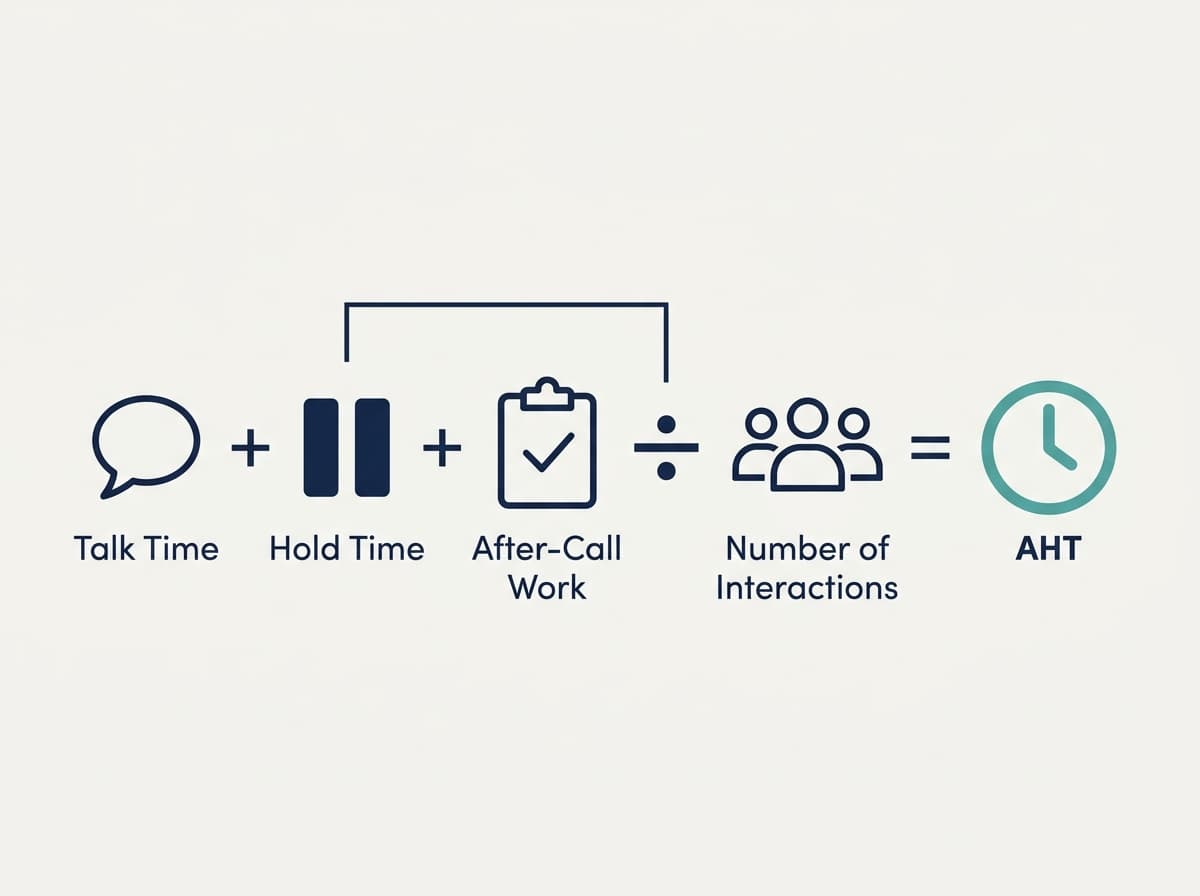
Average handling time (AHT) is a call center metric that measures the average duration of a customer interaction, from initial contact through the completion of any related follow-up work. It has three components:
- Talk time — the time an agent spends actively speaking with the customer
- Hold time — the time a customer waits while the agent looks something up, checks with a colleague, or processes a request
- After-call work (ACW) — the wrap-up time an agent spends updating records, logging notes, or completing follow-up tasks once the conversation has ended
AHT isn't limited to phone calls. Contact centers now track average handle time across chat, email, and messaging too — anywhere "handling" an interaction takes measurable time. The metric is sometimes called average handling time and sometimes average handle time; both refer to the same calculation.
How to Calculate AHT
The average handle time formula is straightforward:
AHT = (Total talk time + Total hold time + Total after-call work) ÷ Total number of interactions
A Worked Example
Say your team handled 300 calls last month, with:
- Talk time: 2,400 minutes
- Hold time: 600 minutes
- After-call work: 300 minutes
AHT = (2,400 + 600 + 300) ÷ 300 = 11 minutes
That's your baseline. The harder — and more useful — question is whether 11 minutes is actually good or bad for what your team does, which depends entirely on industry and call complexity.
What's a Good AHT? Industry Benchmarks
There's no single good average handling time for a call center. A retail order-status call and a technical support escalation aren't the same job and shouldn't be measured against the same target. Typical average handling time by industry looks like this:
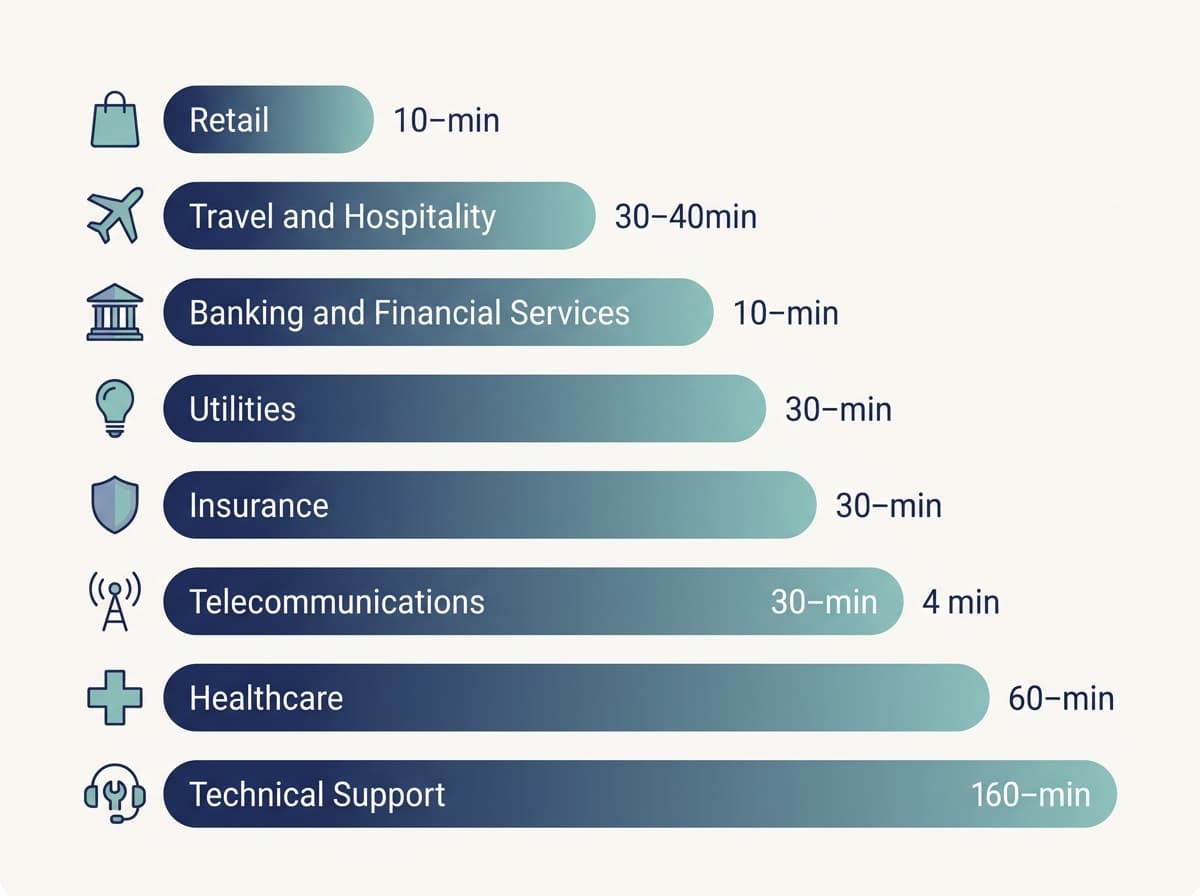
Across industries, the overall average for voice-based support sits around six minutes — but treat that as a reference point, not a target to hit. A technical support line running a 5-minute AHT isn't necessarily beating the industry standard; it may mean agents are rushing complex issues and generating repeat contacts instead of resolving them the first time.
These ranges are broadly consistent with benchmarks reported by COPC Inc., the contact center standards and certification body, which tracks average handle time as one of its core efficiency measures.
Improving AHT vs. Reducing AHT — Not the Same Goal
This is the distinction that separates a useful AHT strategy from a harmful one: reducing average handle time and improving it are different goals, and conflating them is the single most common mistake we see in how teams approach this metric.
Reducing AHT means making calls shorter. On its own, that's easy to do — and easy to do badly. Agents can rush customers, skip verification steps, or cut conversations short to hit a target. The result often looks like a better metric while producing a worse outcome.
Improving AHT means reaching resolution faster without sacrificing first-call resolution (FCR) or customer satisfaction (CSAT). A shorter call that leaves the customer's problem unsolved isn't a win — it's a contact center that will get the same customer back on the phone within a week, which drives both AHT and cost back up anyway, just with an extra interaction attached.
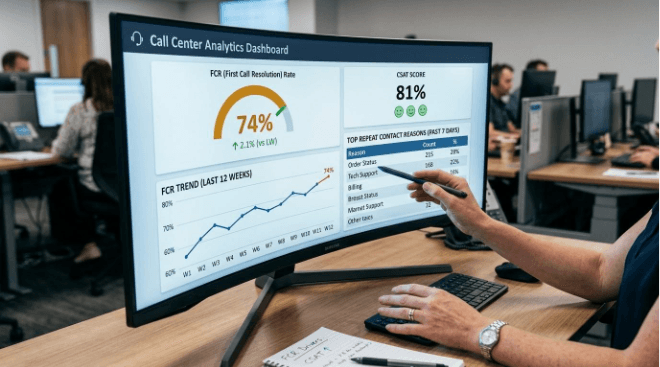
The practical rule: never treat AHT as a target in isolation. Always pair it with FCR and CSAT. If AHT drops while FCR or CSAT also drops, nothing has actually improved — the cost has just moved somewhere less visible on the dashboard.
Signs Your AHT Is Actually a Problem
A long AHT isn't automatically bad; some interactions genuinely need the time. What signals a real problem worth investigating:
- Rising hold time specifically, separate from talk time — usually a sign of slow systems or agents searching for information they should already have on hand
- Falling CSAT alongside rising AHT — customers spending more time to get less satisfying outcomes
- Increasing repeat contacts — customers calling back about the same issue, which quietly inflates AHT across multiple calls instead of resolving it once
- Wide variance between agents handling similar interaction types — usually a training or tooling gap, not a difference in call complexity
- AHT falling while repeat contacts rise — the clearest sign that "reducing" AHT has tipped into rushing customers off the phone
This tracks with Harvard Business Review's influential research on customer effort, which found that repeat contact is one of the strongest predictors of customer disloyalty.
How to Improve AHT: Practical Levers That Work
Fix the knowledge gap, not just the agent. If agents are burning hold time searching for answers, the issue usually isn't the agent — it's that the information isn't easy to find. A well-organized, searchable knowledge base is one of the highest-leverage average handle time reduction tactics, since it removes hold time directly instead of just asking agents to work faster.
Route calls to the right agent the first time. Misrouted calls create their own AHT problem: the customer explains their issue, gets transferred, and explains it again. Smart routing that matches interaction type to agent skill cuts handle time and removes the repeat-explanation friction that erodes CSAT.
Coach specific behaviors, not "be faster." Coaching that targets concrete patterns — unnecessary pauses, redundant verification, inconsistent call structure — moves AHT more reliably than generic pressure to hit a number. Reference real calls, not abstract targets.
Reduce after-call work with templates and auto-population. Unstructured wrap-up time is one of the most underaddressed AHT drivers. Templates that auto-populate known fields and prompt agents only for what's genuinely missing shave real time off every interaction without changing what agents say to customers.
Give agents a way to get unstuck in real time. When an agent hits something they can't resolve alone, the fix shouldn't be a transfer or an open-ended hold. Real-time supervisor escalation, or in-the-moment guidance surfaced automatically from what the customer is saying, keeps the interaction moving instead of punting it elsewhere.
Use conversation data to find the actual bottleneck. Guessing at what's driving AHT up usually means fixing the wrong thing. Analyzing real interactions — where holds cluster, which call types run long, which agents struggle with which topics — turns AHT from a single number into a diagnostic tool.
Address the root cause, not just the symptom. Sometimes the real fix isn't inside the call at all. If a large share of calls ask the same question, that's a signal to fix a broken self-service flow, a confusing bill, or an upstream product issue — solving why customers are calling in the first place is the most permanent AHT improvement there is.
Where AI Agents Actually Fit Into AHT
Most guides mention "AI-powered insights" in passing without saying what that means mechanically. It matters, because the impact on AHT depends entirely on where the AI sits in the workflow.

AI agent-assist tools listen to a live call and surface relevant knowledge-base articles, account details, or suggested next steps in real time — this directly cuts hold time, since the agent isn't searching for the same information manually. Automated after-call summarization generates call notes and updates CRM fields for the agent to review rather than type from scratch, cutting ACW specifically, the AHT component most guides ignore entirely. Voice AI agents and IVR deflection handle fully routine interactions — order status, password resets, simple FAQs — end-to-end. This doesn't reduce AHT for human agents directly; it changes the mix of calls humans handle, typically raising the average complexity — and therefore the AHT — of what's left, while lowering total cost per interaction. Real-time transcription and sentiment signals let supervisors step into a struggling call before it becomes a repeat contact, catching the warning signs above before they show up in next month's numbers.
This distinction matters for how you report on AHT. If you deploy voice AI for simple interactions and then see human-agent AHT increase, that's not a failure — it's the expected result of routine, fast calls being absorbed by AI while complex ones concentrate with human agents. Track AHT changes alongside deflection volume, not in isolation, or you'll misread a genuine efficiency gain as a regression.
This mirrors McKinsey's research on finding the right mix of humans and AI in the contact center, which found the most effective deployments let AI absorb routine volume while human agents concentrate on complex, judgment-heavy interactions.
Key Takeaways
Average handling time is calculated as talk time plus hold time plus after-call work, divided by the number of interactions. What counts as good depends on your industry — use a benchmark range, not a single number, and treat six minutes as a rough cross-industry reference rather than a target. Improving AHT and reducing AHT are different goals; pair AHT with FCR and CSAT so a lower number doesn't quietly mask a worse customer experience. The highest-leverage fixes are usually structural — knowledge base gaps, misrouting, unstructured after-call work — rather than asking agents to move faster. And AI's effect on AHT depends entirely on where it sits in the workflow: assistive tools lower it directly, while deflection tools can raise human-agent AHT even as they lower overall cost per contact.
Nola Neven
AuthorNola Neven is a content strategist in the CX space, focused on turning complex operational problems into clear, credible content that people actually read, reference, and share. Her work sits where content and operations meet. She spends her time understanding how contact centers and help desks really function day to day, where workflows break down, where teams rely on workarounds, and where systems quietly slow everything down.